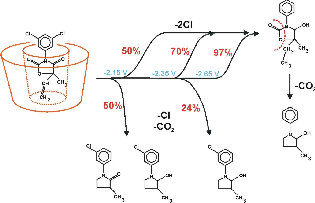
Change of mechanism of reductive decomposition :
- hydrogen bonding facilites reduction coupled to preceeding protonation
- cavity protects the heterocylce and favors the reductive dechlorination
- trapping of a redox intermediate matching better the cavity size
Electron transfer to free form of these pesticides activates the cleavage of the C-N bond yielding chloroanilines as the main decomposition products.
Host-guest complexation with cyclodextrins leads to protection of oxazolidine ring of vinclozolin.
Electron transfer triggers a preferential cleavage of C-Cl bond yielding de-chlorinated products.
Reduction process to dechloro- and desethyl-triazines (common products find in environment) is possible only in the protonized form
Host-guest complexation with cyclodextrins enables reduction process also in neutral solutions. This is made possible by H-bonding inside the cavity of host.
L. Pospíšil, R. Trsková, M.P. Colombini, R. Fuoco, J. Incl. Phenom., 31 (1998) 57.
L. Pospíšil, R. Sokolová, M. Hromadová, S. Gianarelli, R. Fuoco, M.P. Colombini, J. Electroanal. Chem., 517 (2001) 28
M. Hromadová, L. Pospíšil, S. Gianarelli, R. Fuoco, M.P. Colombini, Microchem. J., 73 (2002) 213
M. Hromadová, L. Pospíšil, S. Záliš, N. Fanelli, J. Incl. Phenom., accepted.